Discover Florida Nature
It's time to explore the natural Florida

 Florida
Nature: Florida Ants Florida
Nature: Florida Ants |
|
|
|
|
Ants are a common part of Floridian nature and almost every homeowner in
the state has had to deal with annoying red ant mounds. Besides red
ants, there are several species of ants are found in or around houses in Florida. Ants
can be recognized from other insects because they have a narrow waist
with one or two joints (nodes) between the thorax and abdomen. Also,
ants have elbowed antennae. Winged reproductive ants have four wings
with the first pair being much larger in size than the hind pair. Ants are social insects. Two castes-workers and reproductive's can be found in most colonies. Worker ants, which are sterile females, are seldom winged. Worker ants are often extremely variable in size and appearance within a given species. The function of the worker ant is to construct, repair, and defend the nest; and feed the immature and adult ants of the colony, including the queen. Reproductive females normally have wings but lose them after mating, so queens do not have wings. The primary function of the queen is reproduction; however, in some of the more highly specialized ants the queen cares for and feeds the first brood of workers on her salivary secretions. The queen may live for many years and in some species is replaced by a daughter queen. Depending on the species, ants can have one or more queens. The male ant is usually winged and retains its wings until death. The sole function of the male ant is to mate with unfertilized female reproductive ants. After mating occurs, the male dies. Males are produced in old or very large colonies where there is an abundance of food. After reaching maturity, the male usually doesn't remain in the colony very long. 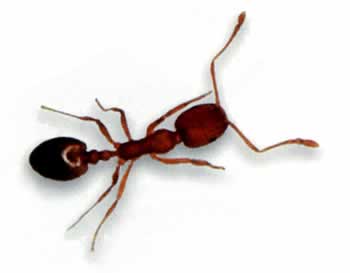 Pharaoh
Ants- These small red-to-yellowish ants can be found trailing
anywhere within a structure. They can nest in wall voids, cabinets,
boxes of food and any other accessible crevices and spaces. Pharaoh ants
are known to invade sick rooms and feed on blood plasma and wound
dressings. Their colonies have multiple queens and can split into small
groups, spreading very rapidly. In subtropical areas, Pharaoh Ants
readily nest outside in leaf debris found on or near structures. Pharaoh
Ants- These small red-to-yellowish ants can be found trailing
anywhere within a structure. They can nest in wall voids, cabinets,
boxes of food and any other accessible crevices and spaces. Pharaoh ants
are known to invade sick rooms and feed on blood plasma and wound
dressings. Their colonies have multiple queens and can split into small
groups, spreading very rapidly. In subtropical areas, Pharaoh Ants
readily nest outside in leaf debris found on or near structures.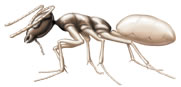 Ghost
Ants- Ghost ants look like tiny, white apparitions who suddenly
appear and seem to disappear just as quickly. Workers are are 1/16 of an
inch in length. The legs, pedicel, gaster, and antennae are pale, almost
translucent, in color and the head and thorax are darker. For this
reason, the ghost ant is also known in some areas as the black-headed
ant. Colonies of ghost ants tend to be moderate to large in size and
multiple queens are present. New colonies are started by "budding" where
one or more reproductive females, several workers, and possibly some
brood(larvae and pupae) migrate to a new nesting site. Ghost ants are
common in south Florida, and can be found as far north as Gainesville,
within the state. Ghost
Ants- Ghost ants look like tiny, white apparitions who suddenly
appear and seem to disappear just as quickly. Workers are are 1/16 of an
inch in length. The legs, pedicel, gaster, and antennae are pale, almost
translucent, in color and the head and thorax are darker. For this
reason, the ghost ant is also known in some areas as the black-headed
ant. Colonies of ghost ants tend to be moderate to large in size and
multiple queens are present. New colonies are started by "budding" where
one or more reproductive females, several workers, and possibly some
brood(larvae and pupae) migrate to a new nesting site. Ghost ants are
common in south Florida, and can be found as far north as Gainesville,
within the state.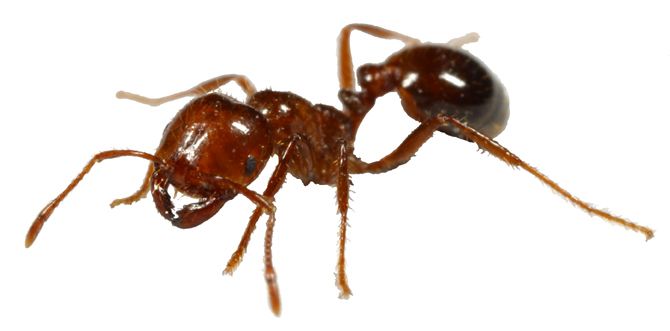 Fire
Ants- Two species of fire ants are found in Florida, the
notorious red imported fire ant (RIFA), followed by the much less
common tropical or native fire ant. The red imported fire ant is a
small reddish brown ant from South America that found their way to
Florida. Thriving on sunshine and dug-up soil, the imported Fire Ant is
now found in every Florida county. Fire Ants are one of the most
aggressive ants that we have in the United States. When a fire ant mound
is disturbed, workers boil to the surface, run up any legs or arms in
the vicinity, grab the victim's skin in their mandibles and sting in
response to the slightest movement. The attacks are coordinated and
dozens or even hundreds of workers sting in unison. The sting of the
RIFA possesses venom of an alkaloid nature, which exhibits potent
necrotoxic activity. Approximately 95% of the venom is composed of these
alkaloids, which are responsible for both the pain and white pustule
that appears approximately one day after the sting occurs. The remainder
of the venom contains an aqueous solution of proteins, peptides, and
other small molecules that produce the allergic reaction in
hypersensitive individuals. Fire ants live in colonies that may have
100,000 to 500,000 ants. The queen of the colony can lay from 1500 to
5000 eggs per day, never leaves the nest and can live for many years.
Worker ants take care of the queen and her eggs, build the nest, defend
the colony, and find food. Preferred food of fire ants consists of
protein-rich sources such as insects and seeds. Winged male and female
ants fly from the colony in the spring and summer to mate in the air.
The males die and the females become queens that start new colonies. Fire
Ants- Two species of fire ants are found in Florida, the
notorious red imported fire ant (RIFA), followed by the much less
common tropical or native fire ant. The red imported fire ant is a
small reddish brown ant from South America that found their way to
Florida. Thriving on sunshine and dug-up soil, the imported Fire Ant is
now found in every Florida county. Fire Ants are one of the most
aggressive ants that we have in the United States. When a fire ant mound
is disturbed, workers boil to the surface, run up any legs or arms in
the vicinity, grab the victim's skin in their mandibles and sting in
response to the slightest movement. The attacks are coordinated and
dozens or even hundreds of workers sting in unison. The sting of the
RIFA possesses venom of an alkaloid nature, which exhibits potent
necrotoxic activity. Approximately 95% of the venom is composed of these
alkaloids, which are responsible for both the pain and white pustule
that appears approximately one day after the sting occurs. The remainder
of the venom contains an aqueous solution of proteins, peptides, and
other small molecules that produce the allergic reaction in
hypersensitive individuals. Fire ants live in colonies that may have
100,000 to 500,000 ants. The queen of the colony can lay from 1500 to
5000 eggs per day, never leaves the nest and can live for many years.
Worker ants take care of the queen and her eggs, build the nest, defend
the colony, and find food. Preferred food of fire ants consists of
protein-rich sources such as insects and seeds. Winged male and female
ants fly from the colony in the spring and summer to mate in the air.
The males die and the females become queens that start new colonies.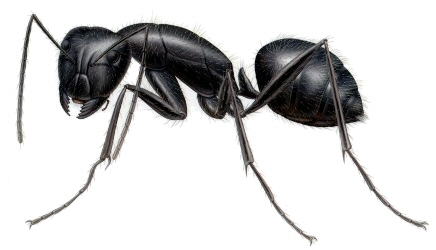 Carpenter
Ants- The largest of the ant family, the carpenter ant ranges
from 1/4 to 3/4 inches (3/5-2 cm), has a constricted waist, bent
antennae and is black, reddish-black or brownish black in color.
Carpenter ants feed on sources of protein and sugar. Outdoors, carpenter
ants feed on living and dead insects. They are also very attracted to
honeydew, a sweet liquid produced by
aphids and scale insects. Aphids and scales feed on trees, shrubs,
and other plants. Indoors, carpenter ants feed on meats, as well as
syrup, honey, sugar, jelly, and other sweets. Carpenter ants do not eat
wood, as many people imagine. They remove wood as they create galleries
and tunnels. Carpenter ants nest in moist wood including rotting trees,
tree roots, tree stumps, and logs or boards lying on the ground.
Carpenter ants can also nest in moist or decayed wood inside buildings.
Wood decay may be caused by exposure to leaks, condensation, or poor air
circulation. Nests have been found behind bathroom tiles; around tubs,
sinks, showers, and dishwashers; under roofing, in attic beams, and
under subfloor insulation; and in hollow spaces such as doors, curtain
rods, and wall voids. Carpenter ants may also nest in foam insulation. Carpenter
Ants- The largest of the ant family, the carpenter ant ranges
from 1/4 to 3/4 inches (3/5-2 cm), has a constricted waist, bent
antennae and is black, reddish-black or brownish black in color.
Carpenter ants feed on sources of protein and sugar. Outdoors, carpenter
ants feed on living and dead insects. They are also very attracted to
honeydew, a sweet liquid produced by
aphids and scale insects. Aphids and scales feed on trees, shrubs,
and other plants. Indoors, carpenter ants feed on meats, as well as
syrup, honey, sugar, jelly, and other sweets. Carpenter ants do not eat
wood, as many people imagine. They remove wood as they create galleries
and tunnels. Carpenter ants nest in moist wood including rotting trees,
tree roots, tree stumps, and logs or boards lying on the ground.
Carpenter ants can also nest in moist or decayed wood inside buildings.
Wood decay may be caused by exposure to leaks, condensation, or poor air
circulation. Nests have been found behind bathroom tiles; around tubs,
sinks, showers, and dishwashers; under roofing, in attic beams, and
under subfloor insulation; and in hollow spaces such as doors, curtain
rods, and wall voids. Carpenter ants may also nest in foam insulation. |
|
 Follow
us on Facebook Follow
us on Facebook Advertise | Privacy Statement | Dog Encyclopedia | Video |Contact | Alaska Nature |
|
