Discover Florida Nature
It's time to explore the natural Florida

 Florida
Birds: Waterfowl Florida
Birds: Waterfowl |
|
|
|
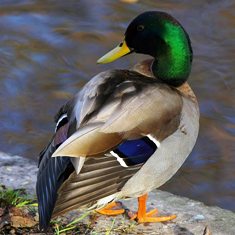 Mallard
Duck- Historically, wild mallards normally winter in Florida in
widely scattered, small flocks and are seldom seen in large
concentrations except in some of the northern counties. These wild birds
migrate out of our state to northern breeding areas in the spring and
are not present in Florida during the mottled duck breeding season. The
green head and yellow bill of the mallard duck is a familiar sight to
many people living in the Northern hemisphere. In fact, the mallard is
thought to be the most abundant and wide-ranging duck on Earth. The
male, or drake, is the more distinctively colored of the mallards. Its
iconic green head sits atop a white neckband that sets off a
chestnut-colored chest and gray body. Females are mottled drab brown in
color, but sport iridescent purple-blue wing feathers that are visible
as a patch on their sides. They grow to about 26 inches in length and
can weigh up to 3 pounds. Mallards prefer calm, shallow sanctuaries, but
can be found in almost any body of freshwater across Asia, Europe, and
North America. They’re also found in saltwater and brackish water and
are commonly found in wetlands. Mated pairs migrate to and breed in the
northern parts of their range and build nests on the ground or in a
protected cavity. Mallard
Duck- Historically, wild mallards normally winter in Florida in
widely scattered, small flocks and are seldom seen in large
concentrations except in some of the northern counties. These wild birds
migrate out of our state to northern breeding areas in the spring and
are not present in Florida during the mottled duck breeding season. The
green head and yellow bill of the mallard duck is a familiar sight to
many people living in the Northern hemisphere. In fact, the mallard is
thought to be the most abundant and wide-ranging duck on Earth. The
male, or drake, is the more distinctively colored of the mallards. Its
iconic green head sits atop a white neckband that sets off a
chestnut-colored chest and gray body. Females are mottled drab brown in
color, but sport iridescent purple-blue wing feathers that are visible
as a patch on their sides. They grow to about 26 inches in length and
can weigh up to 3 pounds. Mallards prefer calm, shallow sanctuaries, but
can be found in almost any body of freshwater across Asia, Europe, and
North America. They’re also found in saltwater and brackish water and
are commonly found in wetlands. Mated pairs migrate to and breed in the
northern parts of their range and build nests on the ground or in a
protected cavity. 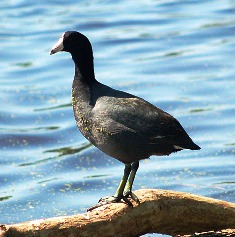 American
Coot- The American Coot is a medium-sized bird with a white
bill, yellow legs, and lobed toes. The body is dark gray to black with a
blackish head and neck. Some of the undertail coverts are white and
visible, especially during display. Juveniles are paler and have
greenish-gray legs. The downy chick's plumage is a colorful orange on
the head and neck. In flight, coots may be distinguished by a white
trailing edge on most of the wing. American Coots are noisy, gregarious
members of the rail family. They propel themselves through the water by
pumping their heads back and forth. Flocks often forage along the shore
or on lawns. They also dive for aquatic plants. To become airborne, they
must scramble across the water with wings flapping vigorously. Coots
will aggressively defend nesting territories, attacking each other with
their feet. Opportunistic feeders, coots eat mostly plant material but
will also feed on small fish, tadpoles, snails, worms, insects, and eggs
of other birds. The nest, built by both sexes, is a floating platform
made of stems of marsh plants. It is concealed in vegetation and
anchored to surrounding plants. Females lay 6-11 eggs, and both sexes
incubate. The young are able to swim soon after hatching and follow the
parents to be fed. American
Coot- The American Coot is a medium-sized bird with a white
bill, yellow legs, and lobed toes. The body is dark gray to black with a
blackish head and neck. Some of the undertail coverts are white and
visible, especially during display. Juveniles are paler and have
greenish-gray legs. The downy chick's plumage is a colorful orange on
the head and neck. In flight, coots may be distinguished by a white
trailing edge on most of the wing. American Coots are noisy, gregarious
members of the rail family. They propel themselves through the water by
pumping their heads back and forth. Flocks often forage along the shore
or on lawns. They also dive for aquatic plants. To become airborne, they
must scramble across the water with wings flapping vigorously. Coots
will aggressively defend nesting territories, attacking each other with
their feet. Opportunistic feeders, coots eat mostly plant material but
will also feed on small fish, tadpoles, snails, worms, insects, and eggs
of other birds. The nest, built by both sexes, is a floating platform
made of stems of marsh plants. It is concealed in vegetation and
anchored to surrounding plants. Females lay 6-11 eggs, and both sexes
incubate. The young are able to swim soon after hatching and follow the
parents to be fed.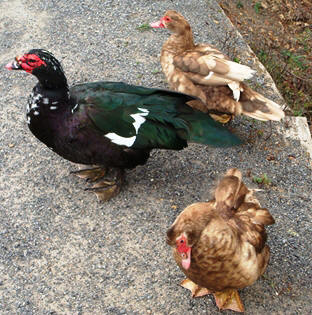 Muscovy-
The wild Muscovy Duck is all-dark apart from the white in the wings,
with long talons on its feet and a wide flat tail. Numerous colorations
are now seen, including all, or mostly, white muscovies and even some
brown-phase specimens. The male is 86 cm long and weighs 3 kg, much
larger than the 64 cm long, 1.3 kg female. His most distinctive features
are a bare red face with a pronounced caruncle at the base of the bill
and a low erectile crest of feathers. Hens and juvenile birds have
smaller, less bumpy face masks. They are smaller with a more slender
appearance than the male. Significant feral populations of Muscovy exist
in Florida and southern Texas. Muscovy-
The wild Muscovy Duck is all-dark apart from the white in the wings,
with long talons on its feet and a wide flat tail. Numerous colorations
are now seen, including all, or mostly, white muscovies and even some
brown-phase specimens. The male is 86 cm long and weighs 3 kg, much
larger than the 64 cm long, 1.3 kg female. His most distinctive features
are a bare red face with a pronounced caruncle at the base of the bill
and a low erectile crest of feathers. Hens and juvenile birds have
smaller, less bumpy face masks. They are smaller with a more slender
appearance than the male. Significant feral populations of Muscovy exist
in Florida and southern Texas. 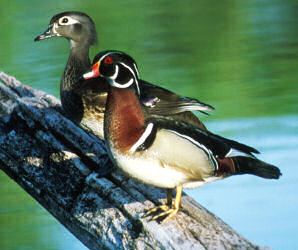 Wood
Duck- A colorful duck of wooded swamps and stream sides, the
Wood Duck is one of only a few North American ducks that nest in trees.
Many people consider it to be the most beautiful of all waterfowl. The
Wood Duck nests in trees near water, sometimes directly over water, but
other times up to 1.2 miles away. After hatching, the ducklings jump
down from the nest tree and make their way to water. The mother calls
them to her, but does not help them in any way. The ducklings may jump
from heights of up to 290 feet without injury! Wood Ducks pair up in
January, and most birds arriving at the breeding grounds in the spring
are already paired. The Wood Duck is the only North American duck that
regularly produces two broods in one year. Natural cavities for nesting
are scarce, and the Wood Duck readily uses nest boxes provided for it.
If nest boxes are placed too close together, many females lay eggs in
the nests of other females. These "dump" nests can have up to 40 eggs. Wood
Duck- A colorful duck of wooded swamps and stream sides, the
Wood Duck is one of only a few North American ducks that nest in trees.
Many people consider it to be the most beautiful of all waterfowl. The
Wood Duck nests in trees near water, sometimes directly over water, but
other times up to 1.2 miles away. After hatching, the ducklings jump
down from the nest tree and make their way to water. The mother calls
them to her, but does not help them in any way. The ducklings may jump
from heights of up to 290 feet without injury! Wood Ducks pair up in
January, and most birds arriving at the breeding grounds in the spring
are already paired. The Wood Duck is the only North American duck that
regularly produces two broods in one year. Natural cavities for nesting
are scarce, and the Wood Duck readily uses nest boxes provided for it.
If nest boxes are placed too close together, many females lay eggs in
the nests of other females. These "dump" nests can have up to 40 eggs.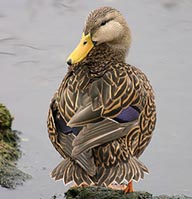 Florida
Mottled Duck- The mottled duck is a non-migratory, close
relative of the mallard. The Florida mottled duck, often called the
Florida duck or Florida mallard, is a unique subspecies found only in
peninsular Florida, residing in both brackish and freshwater marshes.
The Florida mottled duck spends its entire life within the state and has
inhabited Florida for thousands of years. Mottled ducks are large and
brown in color but appear very dark when viewed at a distance. Mottled
ducks are darker than female mallards, but slightly lighter in color
than black ducks. Approximately 40 percent of the mottled duck's diet
consists of animal matter such as insects, snails, mollusks, crayfish
and small fish. The remainder of its diet is composed of grass seeds,
stems, and roots; seeds of other marsh plants; and bayberries. Florida
Mottled Duck- The mottled duck is a non-migratory, close
relative of the mallard. The Florida mottled duck, often called the
Florida duck or Florida mallard, is a unique subspecies found only in
peninsular Florida, residing in both brackish and freshwater marshes.
The Florida mottled duck spends its entire life within the state and has
inhabited Florida for thousands of years. Mottled ducks are large and
brown in color but appear very dark when viewed at a distance. Mottled
ducks are darker than female mallards, but slightly lighter in color
than black ducks. Approximately 40 percent of the mottled duck's diet
consists of animal matter such as insects, snails, mollusks, crayfish
and small fish. The remainder of its diet is composed of grass seeds,
stems, and roots; seeds of other marsh plants; and bayberries. |
|
 Follow
us on Facebook Follow
us on FacebookAdvertise | Privacy Statement | Dog Encyclopedia | Video |Contact | Alaska Nature |
|
