Discover Florida Nature
It's time to explore the natural Florida

 Florida
Lizards: Anoles Florida
Lizards: Anoles |
|
|
|
Anoles are a type of lizard found in Floridian nature. Most anoles are
small in size ranging from 3-6 inches in length. The Knight anole is the
largest anole in the state of Florida and can get to be over 13 inches
long! Green anoles are the most abundant anole in the state and are
sometimes confused with chameleons because of their ability to change
colors. Another
striking feature of the green anole is its dew lap, or throat fan. It is
attached to the throat and displayed by means of a flexible rod of
cartilage which can be swung downward and forward, thereby revealing a
brightly colored patch of skin. Males display their dew lap during
courtship and when defending territory. This display is often
accompanied by a series of head-bobs and push-ups. 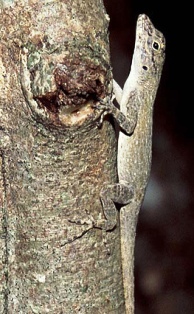 Florida
Bark Anole- Bark anoles are native to Hispaniola. This West
Indian species is abundant in certain areas of Broward and Dade
counties. It was first discovered in Brickell Park, Miami, in 1946.
Florida bark anoles spend their time clinging to trunks and large
branches of trees. and blend remarkably well with the bark. Bark Anoles
are Florida's smallest anole, reaching a maximum length of 12.7 cm (5
in). Its coloration and pattern are changeable, but the Florida Bark
Anole has some shade of gray, green, brown, or almost black. When
sleeping with tail tightly coiled, however, bark anoles may appear
putty-colored or almost white. The Florida Bark Anole has a dark line
across and between the eyes and a prominently banded tail. Two small,
eyelike spots are often present on the back of the head, and 4 vague,
backward-pointing chevrons are often on the back. The dewlap is yellow
with a pale orange blush. Florida
Bark Anole- Bark anoles are native to Hispaniola. This West
Indian species is abundant in certain areas of Broward and Dade
counties. It was first discovered in Brickell Park, Miami, in 1946.
Florida bark anoles spend their time clinging to trunks and large
branches of trees. and blend remarkably well with the bark. Bark Anoles
are Florida's smallest anole, reaching a maximum length of 12.7 cm (5
in). Its coloration and pattern are changeable, but the Florida Bark
Anole has some shade of gray, green, brown, or almost black. When
sleeping with tail tightly coiled, however, bark anoles may appear
putty-colored or almost white. The Florida Bark Anole has a dark line
across and between the eyes and a prominently banded tail. Two small,
eyelike spots are often present on the back of the head, and 4 vague,
backward-pointing chevrons are often on the back. The dewlap is yellow
with a pale orange blush.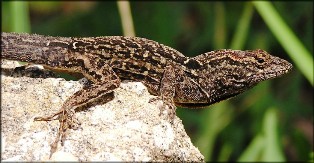 Cuban
Brown Anole- The brown anole is native to Cuba, the Bahamas,
and their satellite islands, and six subspecies occur throughout the
Caribbean. Cuban brown anoles are primarily active in daylight, but
sometimes they feed around lights at night. Voracious eaters, the brown
anole devours large amounts of insects, while the anole themselves are a
a readily available food source for many Florida snakes and birds. Cuban
Brown Anoles eat their shredded skin and recycle the minerals contained
in within it. Cuban Brown anoles have highly variable patterns on their
backs and are usually three to five inches long. Cuban
Brown Anole- The brown anole is native to Cuba, the Bahamas,
and their satellite islands, and six subspecies occur throughout the
Caribbean. Cuban brown anoles are primarily active in daylight, but
sometimes they feed around lights at night. Voracious eaters, the brown
anole devours large amounts of insects, while the anole themselves are a
a readily available food source for many Florida snakes and birds. Cuban
Brown Anoles eat their shredded skin and recycle the minerals contained
in within it. Cuban Brown anoles have highly variable patterns on their
backs and are usually three to five inches long.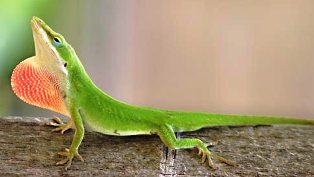 Green
Anole- The green anole is by far the most common anole in the
state of Florida, Sometimes called chameleons, these anoles change from
green to brown to blend into the environment. Although the green anole
is the only anole species native to the U.S., several other species have
been introduced in Florida and are expanding their ranges northward.
Green Anoles are generally arboreal (living in trees) but can be found
almost anywhere. Anoles are commonly found in suburban or even urban
areas and can often be seen perched on fences and rooftops. Green Anoles
are active by day in warm weather and often bask in vegetation,
occasionally charging away from a basking spot to grab and inset or
chase off a rival anole. During cool weather anoles are often found
hiding under tree bark, shingles, or in rotten logs. Sometimes many
anoles can be found taking refuge in one spot. Green Anoles eat a wide
variety of insects, spiders, and other
invertebrates. Throughout the warm months, female green anoles lay
single, round, eggs, in moist soil or rotten wood. Young green anoles
resemble miniature adults. Green
Anole- The green anole is by far the most common anole in the
state of Florida, Sometimes called chameleons, these anoles change from
green to brown to blend into the environment. Although the green anole
is the only anole species native to the U.S., several other species have
been introduced in Florida and are expanding their ranges northward.
Green Anoles are generally arboreal (living in trees) but can be found
almost anywhere. Anoles are commonly found in suburban or even urban
areas and can often be seen perched on fences and rooftops. Green Anoles
are active by day in warm weather and often bask in vegetation,
occasionally charging away from a basking spot to grab and inset or
chase off a rival anole. During cool weather anoles are often found
hiding under tree bark, shingles, or in rotten logs. Sometimes many
anoles can be found taking refuge in one spot. Green Anoles eat a wide
variety of insects, spiders, and other
invertebrates. Throughout the warm months, female green anoles lay
single, round, eggs, in moist soil or rotten wood. Young green anoles
resemble miniature adults.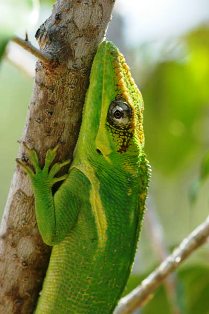 Knight
Anole- Knight anoles are the largest of the Anoles, growing in
length from 13" to 19-3/8". Knight Anoles have a large and bony head
which gives the lizard a profile reminiscent of the knight in chess,
hence the name. Their eyes can move independently, and the knight
anole's tail is often longer than the entire body and has a jagged
upper edge which at first sight reminds people of an iguana. Knight
anoles have special adhesive lamella on their five clawed toes that
allow them to stick to surfaces making it easier for them to run. The
body of the knight Anole is covered with small granular scales with two
white or yellowish stripes below each eye and over each shoulder. Knight
Anole are a bright green color, which can change to a light brown with
yellow markings. Their color change depends on their mood, temperature,
or other types of stimuli. Yellow areas may appear and disappear around
the tail. Males are usually larger than females and have a dew lap, or
throat fan. Knight anoles are active during the day rarely leaving the
trees they live in. They will hunt and eat almost anything smaller than
themselves such as insects and spiders, other
lizards,
tree frogs, nestling birds and small
mammals. While they do not have large teeth, their teeth are sharp and a
Knight Anole has very strong jaw muscles. Knight anoles can inflict a
painful bite if carelessly handled and aggravated. Knight Anoles only
eat live prey as the prey must move to be detected by the lizard. Knight
Anole- Knight anoles are the largest of the Anoles, growing in
length from 13" to 19-3/8". Knight Anoles have a large and bony head
which gives the lizard a profile reminiscent of the knight in chess,
hence the name. Their eyes can move independently, and the knight
anole's tail is often longer than the entire body and has a jagged
upper edge which at first sight reminds people of an iguana. Knight
anoles have special adhesive lamella on their five clawed toes that
allow them to stick to surfaces making it easier for them to run. The
body of the knight Anole is covered with small granular scales with two
white or yellowish stripes below each eye and over each shoulder. Knight
Anole are a bright green color, which can change to a light brown with
yellow markings. Their color change depends on their mood, temperature,
or other types of stimuli. Yellow areas may appear and disappear around
the tail. Males are usually larger than females and have a dew lap, or
throat fan. Knight anoles are active during the day rarely leaving the
trees they live in. They will hunt and eat almost anything smaller than
themselves such as insects and spiders, other
lizards,
tree frogs, nestling birds and small
mammals. While they do not have large teeth, their teeth are sharp and a
Knight Anole has very strong jaw muscles. Knight anoles can inflict a
painful bite if carelessly handled and aggravated. Knight Anoles only
eat live prey as the prey must move to be detected by the lizard. |
|
 Follow
us on Facebook Follow
us on Facebook Advertise | Privacy Statement | Dog Encyclopedia | Video |Contact | Alaska Nature |
|
