Discover Florida Nature
It's time to explore the natural Florida

 Florida
Climate: Weather Charts Florida
Climate: Weather Charts |
|
|
|
Florida Average Rainfall-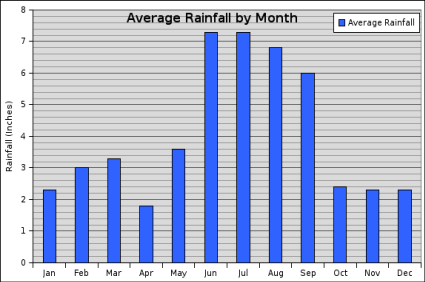 Florida
is split into two climatic zones: warm temperate in the north and
tropical in the south. That said, most of the state experiences warm
weather and plenty of sunshine year round. Being tropical, the period
from late spring to early autumn does tend to see a lot of rainfall
which can occur on an almost daily basis. However, this rainfall
generally arrives in the form of a thunderstorm, which can appear out of
the blue on a clear day, only to disappear again an hour or so later.
In winter, the weather stays warm, but is generally a lot drier. Snow is
a very rare occurrence in Florida, although has been known to occur in
the Panhandle in the north of the state. Florida
is split into two climatic zones: warm temperate in the north and
tropical in the south. That said, most of the state experiences warm
weather and plenty of sunshine year round. Being tropical, the period
from late spring to early autumn does tend to see a lot of rainfall
which can occur on an almost daily basis. However, this rainfall
generally arrives in the form of a thunderstorm, which can appear out of
the blue on a clear day, only to disappear again an hour or so later.
In winter, the weather stays warm, but is generally a lot drier. Snow is
a very rare occurrence in Florida, although has been known to occur in
the Panhandle in the north of the state. Florida Average Temperatures- 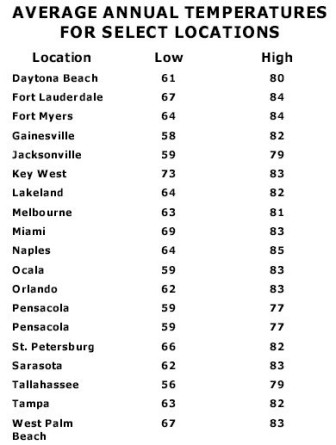 Summers
throughout the state are long, warm, and fairly humid. Winters are mild
with periodic invasions of cool to occasionally cold air. Coastal areas
in all sections of Florida average slightly warmer temperatures in
winter and cooler ones in summer. The primary factors affecting the
state's climate are latitude and numerous inland lakes. Proximity to the
currents of the Atlantic Ocean and the Gulf of Mexico also plays an
important role. The best months temperature-wise are November through
April, which is probably why so many “snowbirds” are down here during
that time. Although southern Florida is 400 miles closer to the tropics
than northern Florida, it doesn't feel like it because of the prevailing
sea breeze. Southern Florida is one of the warmest places on the United
States mainland in winter. The highest recorded temperature was 109
degrees at Monticello, in Florida's Panhandle, on June 29, 1931. The
lowest recorded temperature was 2 degrees below zero at Tallahassee on
February 13, 1899. Summers
throughout the state are long, warm, and fairly humid. Winters are mild
with periodic invasions of cool to occasionally cold air. Coastal areas
in all sections of Florida average slightly warmer temperatures in
winter and cooler ones in summer. The primary factors affecting the
state's climate are latitude and numerous inland lakes. Proximity to the
currents of the Atlantic Ocean and the Gulf of Mexico also plays an
important role. The best months temperature-wise are November through
April, which is probably why so many “snowbirds” are down here during
that time. Although southern Florida is 400 miles closer to the tropics
than northern Florida, it doesn't feel like it because of the prevailing
sea breeze. Southern Florida is one of the warmest places on the United
States mainland in winter. The highest recorded temperature was 109
degrees at Monticello, in Florida's Panhandle, on June 29, 1931. The
lowest recorded temperature was 2 degrees below zero at Tallahassee on
February 13, 1899.Heat index- 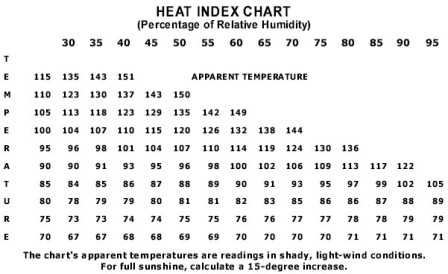 Florida's
humid climate is attributed to the fact that no point in the state is
more than 60 miles from salt water, and no more than 345 feet above sea
level. Humidity is the degree of wetness or dryness of the air and is
measured by a percentage ratio called "relative humidity." The warmer
the air becomes, the more moisture it can hold, therefore, a person can
feel the humidity on a warm day with 80 percent humidity than on a cold
day with the same humidity. This heat index chart determines how hot the
weather feels on a given day. The chart combines Fahrenheit air
temperature and relative humidity. Florida's
humid climate is attributed to the fact that no point in the state is
more than 60 miles from salt water, and no more than 345 feet above sea
level. Humidity is the degree of wetness or dryness of the air and is
measured by a percentage ratio called "relative humidity." The warmer
the air becomes, the more moisture it can hold, therefore, a person can
feel the humidity on a warm day with 80 percent humidity than on a cold
day with the same humidity. This heat index chart determines how hot the
weather feels on a given day. The chart combines Fahrenheit air
temperature and relative humidity.Hurricane Strikes- 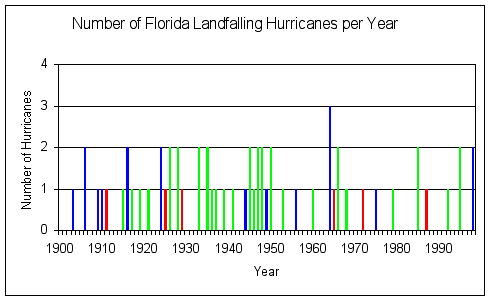 The
number of hurricanes that made landfall in Florida each year between
1900 and 1998. El Niño years are indicated in red, neutral years are
shown in green and La Niña years are indicated in blue A "landfalling"
hurricane is defined as a storm that made at least one Florida, Gulf
Coast, or East Coast landfall with winds greater than or equal to 64
kts. The
number of hurricanes that made landfall in Florida each year between
1900 and 1998. El Niño years are indicated in red, neutral years are
shown in green and La Niña years are indicated in blue A "landfalling"
hurricane is defined as a storm that made at least one Florida, Gulf
Coast, or East Coast landfall with winds greater than or equal to 64
kts. |
|
 Follow
us on Facebook Follow
us on FacebookAdvertise | Privacy Statement | Dog Encyclopedia | Video |Contact | Alaska Nature |
|
