Discover Florida Nature
It's time to explore the natural Florida

 Florida
Tribes: Apalachee Indians Florida
Tribes: Apalachee Indians |
|
|
|
 At
the beginning of the historic period, in 1492 AD, it is conservatively
estimated that there were about 100,000 Indians living in Florida. The
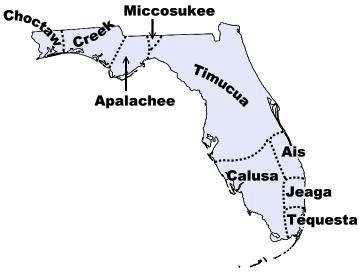
original inhabitants of the area that is now Florida included: The
Apalachee Tribe, The Calusa Tribe,
The Choctaw Tribe,
The Creek Tribe,
The Miccosukee Tribe,
The Tequesta Tribe,
The Jeaga Tribe,
The Ais Tribe, and
The Timucua Tribe.
Although the Seminole Tribe is probably the
most well known Florida tribe of Indians, they were not originally a
single tribe. They were an alliance of Northern Florida and Southern
Georgia natives that banded together in the 1700's to fight the European
invaders, including people from the Creek, Miccosukee, Hitchiti and
Oconee tribes. Later the alliance became even closer, and today the
Seminoles are a united sovereign nation, even though their people speak
two languages and have different cultural backgrounds. For further
information on Florida, you may want to purchase a book from our
Florida Nature
Library. Don't miss our "Nature
Videos" slideshow set to music! At
the beginning of the historic period, in 1492 AD, it is conservatively
estimated that there were about 100,000 Indians living in Florida. The
original inhabitants of the area that is now Florida included: The
Apalachee Tribe, The Calusa Tribe,
The Choctaw Tribe,
The Creek Tribe,
The Miccosukee Tribe,
The Tequesta Tribe,
The Jeaga Tribe,
The Ais Tribe, and
The Timucua Tribe.
Although the Seminole Tribe is probably the
most well known Florida tribe of Indians, they were not originally a
single tribe. They were an alliance of Northern Florida and Southern
Georgia natives that banded together in the 1700's to fight the European
invaders, including people from the Creek, Miccosukee, Hitchiti and
Oconee tribes. Later the alliance became even closer, and today the
Seminoles are a united sovereign nation, even though their people speak
two languages and have different cultural backgrounds. For further
information on Florida, you may want to purchase a book from our
Florida Nature
Library. Don't miss our "Nature
Videos" slideshow set to music!The Apalachee Tribe- From at least A.D. 1000, a group of farming Indians was living in northwest Florida. They were called the Apalachees. Some think the Apalachee language was related to Hitchiti of the Muskhogean language family. The Apalachees’ territory extended from the Aucilla River in the east to the Ochlockonee River in the west. Its northern boundary extended to what is now the Georgia state line, and its southern border was the Gulf of Mexico. Settlements within Apalachee Province were concentrated in today’s Leon and Jefferson counties. Prior to European contact, there were probably at least 50,000-60,000 Apalachees. They were a strong and powerful chiefdom living in widely dispersed villages. Their leaders organized their work, and much of their social, ritual and political life as well. Other tribes respected the Apalachees because they belonged to an advanced Indian civilization, they were prosperous, and they were fierce warriors. For food, the Apalachee grew corn, beans and squash. Men prepared the fields and women tended the crops. Men also hunted bear, deer and small game, while women gathered nuts and berries. Traditionally the men wore deerskin loincloths and women wore Spanish moss skirts. When preparing for battle, the men painted their bodies with red ochre and put feathers in their hair. The de Soto-era capital, Anhaica, became one of the first missions established in Apalachee Province around 1633, and was eventually relocated and renamed San Luis de Talimali. Between 1656 and 1704, San Luis was a principal village of the Apalachee Indians and the Spaniards’ westernmost military, religious, and administrative capital. More than 1,500 Apalachee Indians and Spaniards lived at the mission. Following a series of devastating attacks on Spanish Florida by the British and their Creek Indian allies, Mission San Luis was burned and abandoned by its residents on July 31, 1704. |
|
 Follow
us on Facebook Follow
us on Facebook  Follow
us on Twitter Follow
us on Twitter Advertise | Privacy Statement | Contact | Alaska Nature | Michael Arnold Art| Dog Encyclopedia | Dog Encyclopedia| |
|
